
PRIME NEWS POST
The INDONESIAN, JAKARTA — The Constitutional Court (MK) has granted the entire petition for judicial review of Law No. 31 of 1997 on Military Courts, filed by Lenny Damanik and Eva Meliani Br. Pasaribu, family members of victims of alleged violence involving TNI personnel.
The ruling marks a significant milestone in the struggle to uphold civilian supremacy, strengthen judicial independence, and guarantee access to justice for victims of crimes committed by military personnel.
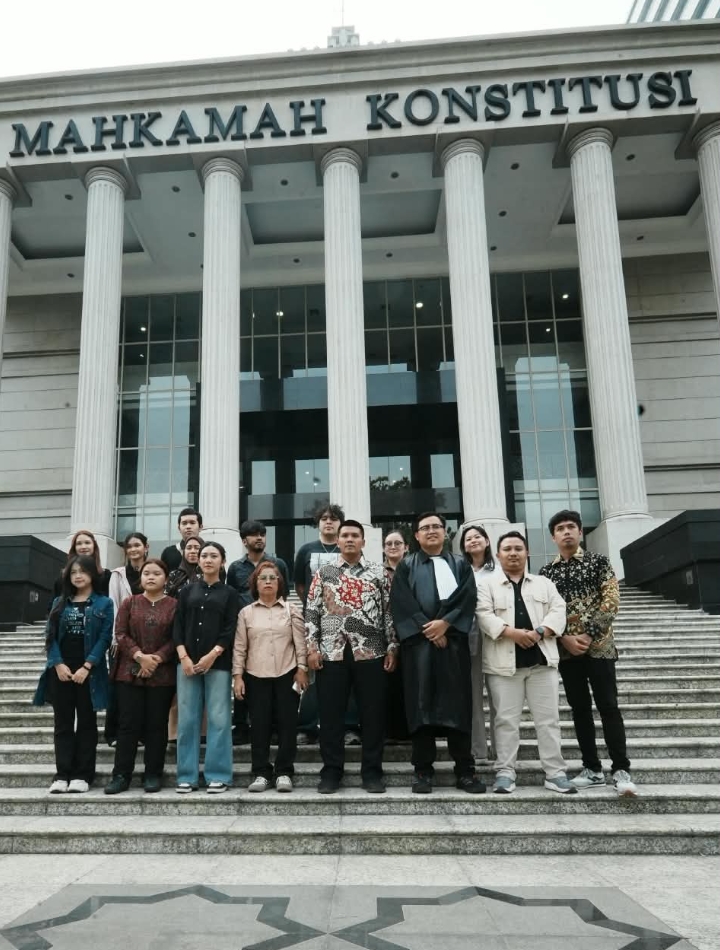
The petitioners attended the ruling hearing in Case No. 260/PUU-XII/2025, accompanied by their legal team from the Civilian Supremacy Coalition, comprising LBH Medan, Imparsial, Themis, and KontraS.
In its ruling, the Court granted the petition in full. It declared that the Military Court Law is inconsistent with the 1945 Constitution and no longer legally binding — on the condition that the law be amended within no later than two years from the date of the ruling.
The decision underscores the urgency of reforming the military justice system, particularly regarding the handling of ordinary criminal offenses committed by military personnel.
LBH Medan welcomed the ruling as a progressive step toward strengthening the rule of law and civilian supremacy. It called on the President and the House of Representatives (DPR) to follow up on the Constitutional Court’s decision by revising Law No. 31 of 1997 without delay.
“This ruling must be the turning point in ending legal uncertainty over jurisdiction when military personnel commit ordinary crimes. Reform cannot wait — victims are entitled to justice and an independent legal process,” stated LBH Medan.
Four Fundamental Flaws in the Military Justice System
In its legal considerations, the Constitutional Court highlighted four critical concerns guiding the need for reform:
First, unclear definition of ‘criminal offense’.
The Court noted ambiguity in the meaning of “criminal offense” under Article 9 of the Military Court Law, and its relationship to military discipline provisions and Article 4 of the Military Penal Code. Clear distinction between ordinary crimes and military-specific crimes is essential to establish firm legal grounds for jurisdiction.
Second, jurisdiction tied to status rather than the crime committed.
Law No. 31/1997 replaced the 1950 legislation but retains a system where jurisdiction depends on whether the perpetrator is a soldier — not on the nature of the offense. Reform must clarify the boundary between military and ordinary crimes, and establish clear rules for determining the proper forum.
Third, compromised judicial independence.
Concerns persist that the appointment and placement of military judges remain tied to the military chain of command. This undermines the appearance of independence and impartiality. The system should align with the principle of an independent judiciary and eventually transition toward a “one-roof system” under the Supreme Court.
Fourth, risk of impunity and fair trial violations.
LBH Medan warns that a justice system overly influenced by military command structures creates conflicts between institutional interests and impartial law enforcement. This must be addressed to prevent impunity — where those responsible escape accountability. The principles of independence, equality before the law, and fair trial must guide all proceedings.
Two Cases Behind the Legal Challenge
The review was driven by two families seeking justice:
– Lenny Damanik is the mother of MHS, who died following alleged abuse by TNI personnel. Soldier Riza Pahlevi was sentenced to 10 months’ imprisonment.
– Eva Meliani Br. Pasaribu is the daughter of journalist Rico Sempurna Pasaribu, who died along with his wife, child, and other family members in a deliberate house fire. The attack reportedly followed Rico’s reporting on an alleged gambling operation run by a soldier identified as Koptu HB. Three civilian defendants have been sentenced to life imprisonment; however, to date, no legal process has reportedly been initiated against Koptu HB, who is alleged to have been involved in the planned killing.
LBH Medan emphasized that both cases illustrate the urgent need for a justice system capable of delivering equal, transparent, and independent accountability. Every allegation must be processed lawfully and based on evidence.
LBH Medan Calls on President, DPR, and TNI Commander to Act
Following the ruling, LBH Medan issued two key demands:
1. The President and the DPR must immediately revise Law No. 31/1997 on Military Courts.
Revision must implement the Constitutional Court’s ruling in Case No. 260/PUU-XII/2025 and clarify jurisdiction over ordinary crimes committed by military personnel, in line with the Court’s considerations.
2. The TNI Commander must respect the ruling and ensure zero impunity.
Law enforcement against military personnel must be transparent, independent, and accountable. No special treatment should obstruct investigations or deny victims their right to justice.
LBH Medan affirmed that this ruling must mark a turning point in reforming Indonesia’s military justice system. The rule of law requires more than just new laws — it requires equal enforcement for all citizens. Reform is expected to restore public trust in law enforcement and ensure every victim has equal access to justice.
This release is submitted for publication as part of ongoing efforts to advance civilian supremacy, judicial independence, and equal justice for all victims of crime.
For media inquiries:
Irvan Saputra, S.H., M.H.
Ricard S.D. Hutapea, S.H.
LBH Medan
Editorial Note: Please verify the following before publication — Case No. 260/PUU-XII/2025, the exact phrasing of the ruling and two-year deadline, the Court’s specific considerations, and details regarding victims, sentences, and the status of ongoing investigations. Where allegations have not yet been proven in court, please use appropriate qualifying language.