

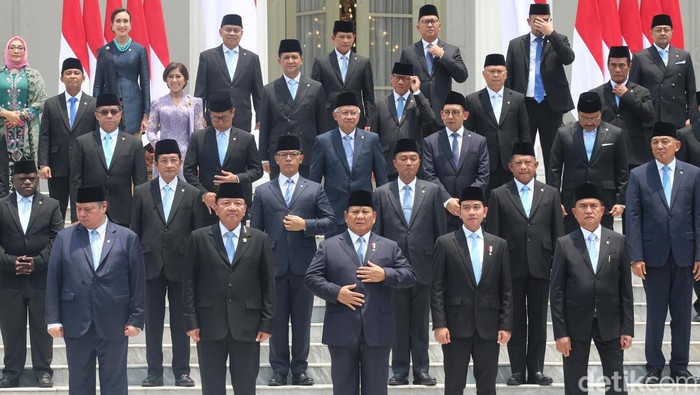
Jakarta – Calls to evaluate the Red and White Cabinet are growing louder. However, the National Circle of Islamic Students (LMI) assesses that the evaluation must not stop at ministerial replacements, but must instead completely dismantle the government’s superstructure, which it deems bloated and wasteful.
The issue of a reshuffle has resurfaced amid scrutiny of the cabinet’s performance. Rahmat Rahyaan, National Coordinator for Legal, Political, and Human Rights Affairs at LMI, described the discourse as a historical call to fundamentally review the government’s design.
“The Red and White Cabinet is a representation of a failed state that manages crises by enlarging its own machinery. It is highly performative in its contradictions. A bloated cabinet is a mirror of a greedy bureaucratic power, siphoning off the people’s surplus value—not for welfare, but to perpetuate structural parasitism (maintaining structures that benefit a select few),” Rahmat said in a written statement on Tuesday (August 6).
According to him, an overly large cabinet structure actually creates an alienation of power. Institutions continue to multiply, yet grow increasingly detached from the people’s material base.
“This is the exceedingly poor law of bureaucratic motion: sectoral egos clash with one another as each attempts to accumulate power and budget as political capital. It becomes a war of all against all within the state machinery,” he asserted.
Rahmat believes that replacing elites without overhauling institutional structures is merely a dialectical joke that fails to address the root of the problem.
“It is as if you’re changing the foreman, but the exploitative production relations between the state and the people remain intact. A new face with the same old ways,” he said.
LMI is urging President Prabowo Subianto to immediately undertake a radical simplification by eliminating overlapping ministerial functions.
LMI also calls for the development of a single, integrated national administrative system as a new synthesis that removes bureaucratic barriers.
“The state is not an entity formed to worship itself. The state exists to serve its citizens, not to glorify its own power. Every rupiah burned to fund overlapping powers is an impoverishment of the real sectors, such as education, health, and research,” Rahmat stated.
LMI asserts that true reform must change the material structure that breeds inefficiency. If only the players are replaced, Rahmat added, history will record it as a colossal drama of the capitalist class extracting the sweat of the people, rather than a progressive improvement in governance.
“If not, it is merely a change of players in the same drama,” he concluded.