
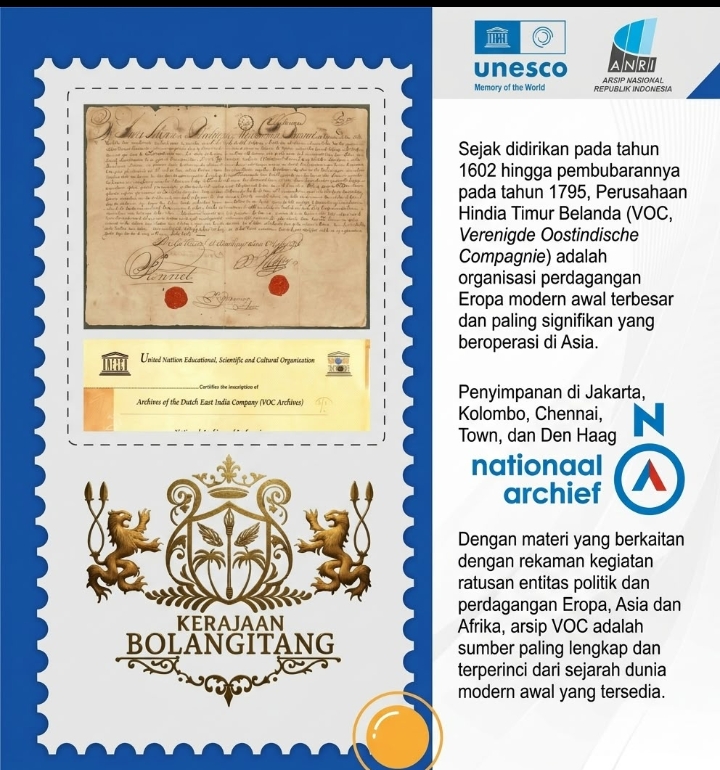
JAKARTA — Historical research conducted at the Nationaal Archief in the Netherlands has opened a new chapter in the study of the Bolangitang Kingdom’s history in North Sulawesi. Two North Sulawesi history researchers, Iftiqar S.A. Ponto and Giovanni R. Babay, completed an in‑depth review in 2026 of Dutch East India Company (VOC) archival records containing genealogical accounts of Bolangitang’s kings and queens.
Their study yielded a series of striking new genealogical findings. The names, family relationships, and lines of succession linking the Bolangitang and Kaidipang royal houses show a historical timeline that differs in several respects from the version of the story widely circulated in existing historical writing.
One key discovery relates to Queen Dona Magdalena Linkakoa of Bolangitang, who is estimated to have reigned from roughly 1677 to 1695. According to the VOC documents, Dona Magdalena was a fifth‑generation descendant from the line of Bolangitang Queens Bilobulawa and Linkakoa, through her husband Mobiling, the King of Kaidipang.
From that lineage, Dona Magdalena had a son named Willem, also recorded as Willem Cornput. The genealogical records indicate Willem was later installed as ruler over both Kaidipang and Bolangitang.
Willem Cornput had three children: Jacomina Kinabi, Albertus Cornput, and Jacobus Cornput. His two sons, Albertus and Jacobus, are listed as having ascended the throne as Kings of Kaidipang.
Jacomina Kinabi meanwhile married Prince Jogugu Class Ponto of Bolangitang, the son of Jogugu Jeremias Solano. Jeremias Solano is noted in the archives as the adopted son of Queen Linkakoa.
Jacomina Kinabi and Jogugu Class Ponto had two children, Israel Ponto and Elisabeth Ponto.
Within the Bolangitang royal administration, Israel Ponto later held the position of Jogugu — a senior post comparable to prime minister, with a strategic role supporting the kingdom’s governance.
Israel Ponto’s son, Nicolaas Ponto, would later serve as Regent of Bolangitang. In the colonial administrative system of the era, the title of Regent referred to a regional leader with substantial governing authority, similar to a local ruler or minor king.
Nicolaas Ponto’s line produced Salomon Ponto, better‑known as Salmon Muda Ponto, listed in the family tree as the first King of Bolangitang after the VOC suspended the kingdom’s formal status in 1677.
This full sequence of names and kinship ties forms a critical new piece of Bolangitang royal‑family history. The VOC files not only map intergenerational relationships within the royal household, they also illuminate the political and administrative links between the Bolangitang and Kaidipang Kingdoms.
VOC Archives Recognized as a Highly Valuable Historical Source
Iftiqar S.A. Ponto described the discoveries as an encouraging development for efforts to reconstruct and refine the recorded history of North Sulawesi’s pre‑colonial kingdoms, especially Bolangitang.
He explained that VOC archives are a vital primary source, containing administrative paperwork, correspondence, bureaucratic logs, and trade records that document royal‑court activities and inter‑kingdom relations of the period.
“This is certainly welcome news for us. The VOC archives are an extremely important historical resource, holding the trading company’s administrative and bureaucratic records. These documents serve as a precious cross‑reference for historical research, including the family lineage of Bolangitang’s kings and queens,” Iftiqar S.A. Ponto stated.
He added that the VOC collection stored at the Netherlands Nationaal Archief is part of the UNESCO Memory of the World documentary heritage register, with preservation and management of the records shared across five countries.
The existence of these files creates a major opportunity for researchers, history enthusiasts, and younger generations to reconstruct past events using verifiable primary documentation.
For that reason, Iftiqar said the Bolangitang lineage findings require further, deeper study: cross‑checking between documents, tracing supporting source material, and expanded historical analysis to build a more complete, accurate historical narrative.
Retracing the Forgotten History of Bolangitang Kingdom
The work carried out by Iftiqar S.A. Ponto and Giovanni R. Babay represents an important contribution to North Sulawesi’s local‑history record. Many colonial‑era documents held overseas still contain untold details on Indonesia’s pre‑colonial kingdoms that have not fully entered mainstream historical writing.
The research also underscores that history cannot rely only on oral tradition and passed‑down stories. Primary‑source archival research, genealogical study, and cross‑comparison between multiple historical records are essential to preserving accurate knowledge across generations.
For Bolangitang’s specific history, the VOC archives open wider research possibilities into bloodlines, political marriages, governing structures, and royal‑succession arrangements involving both the Bolangitang and Kaidipang dynasties.
The work by Iftiqar S.A. Ponto and Giovanni R. Babay is expected to become a tangible contribution to the formal documentation of North Sulawesi’s history, helping ensure the legacy of Indonesia’s ancient kingdoms is not lost to time. Every page in these historical archives preserves pieces of cultural identity, the story of power, and a civilization’s heritage for future generations to learn from. (Edir)
Reported from various media sources //photo from Google documents // contribution by Prime News Post international online media // news.paper