
PRIME NEWS POST
The INDONESIAN, (JAKARTA) — The alleged illegal wiretapping targeting President Prabowo Subianto and several public figures — which has implicated three high-ranking police officers — is no ordinary criminal case. It strikes at the heart of national security, abuse of authority, violation of constitutional rights, and suspected attempts to destroy digital evidence.
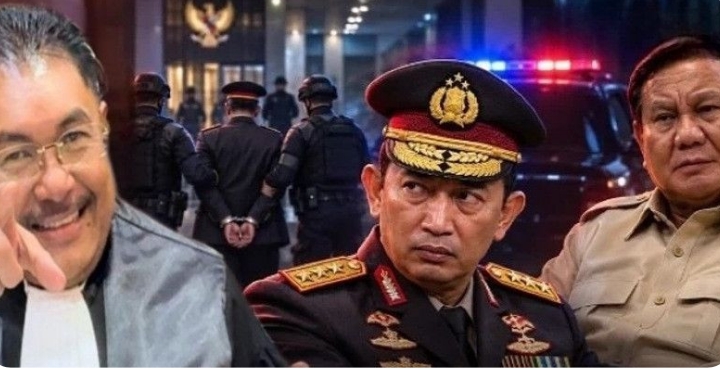
Legal practitioner Dr. Santrawan T. Paparang, S.H., M.H., M.Kn., emphasized that if these allegations are proven true, the acts constitute an extremely serious legal matter that cannot be resolved through mere administrative measures or internal police discipline.
According to him, wiretapping inherently restricts an individual’s right to privacy and may only be carried out under clear legal authority, purpose, and procedure.
“In a state under the law, there is no unlimited power. Office, rank, and authority never grant anyone permission to break the law — least of all to use state institutions to conduct wiretapping without legal basis,” Santrawan stated firmly.
The case came to light when Inspector General Asep Safrudin, Head of the National Police Criminal Investigation Agency (Bareskrim), disclosed alleged unauthorized wiretapping spanning 2025 through 2026.
Numerous telephone numbers — including those belonging to President Prabowo Subianto, state officials, political figures, journalists, civil society organizations, NGOs, and businesspeople — were reportedly entered into the Lawful Interception Management System (LIMS) without verification and without connection to any ongoing legal process.
The three high-ranking officers named as suspects are Listyo Sigit Prabowo (LSP), Ahrie Sonta Nasution (ASN), and Eko Hadi Santoso (EH).
Concerns deepened following allegations that wiretap records were ordered deleted in October 2026. An official police report was subsequently filed by officers on 30 October 2026. Investigators also seized 11 mobile phones, one iPad, and four flash drives.
Illegal Wiretapping Is Not Merely an Administrative Error
Santrawan stressed that the fundamental element to establish is whether the surveillance was conducted unlawfully and without statutory procedure.
He explained that National Police Chief Regulation No. 5 of 2010 governs wiretapping protocols within the force. Surveillance must relate directly to law enforcement objectives and meet all legal requirements.
“If telephone numbers are entered into a surveillance system without a criminal case file, without a formal investigator’s request, and without lawful procedure — the question is no longer simply who violated standard operating procedure. The legal question becomes: who abused their authority, and who must face criminal accountability?” he said.
He insisted that if misuse of the system is proven, no special treatment should be granted simply because those involved hold senior positions in state institutions.
Deleted Data: What Is Being Hidden?
Santrawan drew particular attention to the alleged deletion of wiretap records in October 2026.
He called for digital forensic examination to determine who accessed the system, who issued the orders, exactly what data was removed, when it occurred, and whether copies or recoverable digital traces remain.
“Destroying evidence must not be allowed to obscure the truth. Forensic technology must trace every digital footprint. Those who ordered and those who executed must be held accountable according to their roles,” he stated.
He warned that alleged erasure of electronic information constitutes a separate offense that must be proven independently — it cannot be dismissed as a routine technical matter.
Three Statutes, Three Serious Legal Concerns
Investigators have applied three criminal provisions in this case:
1. Article 258 of the Criminal Code (KUHP) 2023 — unauthorized wiretapping, punishable by up to 10 years’ imprisonment.
2. Article 332(1) and/or (2) of the Criminal Code — unauthorized access to computer systems, carrying a maximum sentence of six years for Article 332(1).
3. Article 32(1) in conjunction with Article 48(1) of the ITE Law — unlawful alteration, damage, deletion, or concealment of electronic information, carrying a maximum penalty of eight years’ imprisonment.
Santrawan noted that the application of multiple charges must be substantiated separately by evidence for each offense. Sentencing authority rests solely with the court.
He also reminded investigators to observe the principle of legality and applicable law based on when the alleged acts occurred — noting that while the surveillance reportedly began in 2025, the new Criminal Code only entered into force on 2 January 2026.
Do Not Stop at Three Suspects!
For Santrawan, the most critical question concerns the possibility of a broader chain of command.
Investigators must identify who authorized server access, who operated the system, who supplied the equipment, how it was funded, and who knew of and approved the operation.
“Technological surveillance operations cannot be examined only at the level of those who carried them out. Investigators must trace who designed, who ordered, who facilitated, and who benefited from this capability. Those executing orders must not be prosecuted while the true architects remain untouched,” he warned.
He also urged investigators to remain open to uncovering additional involvement based on evidence — rather than drawing premature conclusions.
If Even the President Is Targeted, What of the People?
Santrawan highlighted profound constitutional concerns. If unlawful surveillance reached the President and public figures, the privacy of every citizen is equally at stake.
The right to privacy and personal security is enshrined in Article 28G(1) of the 1945 Constitution. The State must ensure that surveillance technology never becomes a tool that itself threatens citizens’ fundamental rights.
“If even the President can be targeted by illegal wiretapping, what chance do ordinary citizens, journalists, activists, and those without power have to protect themselves? This is not just about presidential security — it is about guaranteeing that no one may be subjected to arbitrary surveillance,” he said.
Santrawan affirmed that the rule of law must apply equally. The law cannot be strict toward subordinates yet lenient toward senior officials.
“No institution may serve as a shield against criminal accountability. Anyone proven to have broken the law must face consequences. There must be no impunity, no selective enforcement, and no cover-ups,” he concluded.
For Santrawan, this case represents a true test of Indonesia’s commitment to the rule of law. The public is entitled not only to know who has been named a suspect — but how the operation functioned, who was in control, and whether every responsible party has truly been brought to justice.
“When the State’s own surveillance infrastructure is allegedly misused to spy unlawfully, what is at stake is not merely individual privacy — but the authority of the law and the people’s trust in their government.”
Reported from multiple sources / Special Contributor