
PRIME NEWS POST
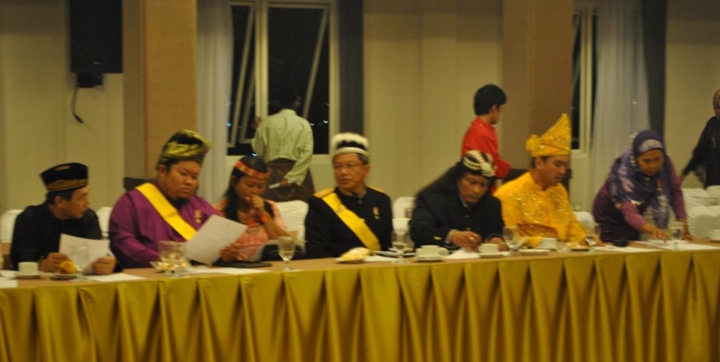
The INDONESIAN , (Jakarta)— During the Communication Forum of the Indonesian Customary Council (MAI), attended by Kings, Sultans, Datuks, Queens, and Customary Leaders from across the archipelago, His Royal Highness (DYMM) Sripaduka Baginda Berdaulat Agung Prof. Dr. Maharaja Srinala Praditha Alpiansyah Rechza, FW, Ph.D., who serves as the Supreme Head of Diraja Nusantara and Maharaja of Kutai Mulawarman, presented a written statement. The statement summarized key points from the Second Session of the Diraja Nusantara Supreme Council held in Tenggarong on September 15, 2013.
In his presentation, DYMM emphasized that the fundamental issue faced by indigenous communities across the archipelago is the failure to fully recognize the position of traditional rulers as holders of territorial sovereignty (ulayat), instead viewing them merely as cultural symbols. This condition has directly led to the rampant issuance of concession permits without customary consent.
Representatives from the Tjantoeng/Cantung Kingdom in Tanah Bumbu, South Kalimantan, reported that since 2005, their customary lands have been encroached upon by coal mining concessions without traditional approval. “State permits are complete, but there is no royal consent. As a result, forests are destroyed, rivers are polluted, and ancestral sites are displaced. The King is considered to have no rights over the land,” they stated during the forum on May 4, 2026.
This phenomenon has resulted in severe consequences, including the loss of vast customary lands, community suffering due to environmental damage, and the diminishing authority of tradition in the eyes of the younger generation. It was even noted that “excavators hold more power than the King’s decree,” a stark illustration of how traditional authority has been sidelined.
Similarly, representatives from Takalar, South Sulawesi, asserted that the root cause lies in the absence of a specific Law on Customary Law Communities. Although Article 18B paragraph (2) of the 1945 Constitution recognizes the existence of indigenous communities, there is currently no operational legal framework to protect ulayat lands. Consequently, systematic land grabbing, social conflicts, and the weakening of the King’s role in protecting their people persist.
The forum also highlighted the importance of developing human resources within indigenous communities. A leader from Muara Kaman Ilir stressed that youth disconnected from traditional values risk becoming agents of environmental destruction. Therefore, it was agreed that traditional rulers must serve as primary educators, implementing learning systems based on “Titi Adat Etam” and establishing a network for customary leadership education nationwide.
International support was conveyed by representatives from the Royal House of Malaysia, who noted that their country has had the Aboriginal Peoples Act since 1954. In practice, any activity concerning customary land requires the approval of traditional leaders and the King as protector. This experience serves as a vital reference, proving that legal recognition of tradition is not only possible but also effective in balancing development and preservation.
Based on these discussions, the Second Session of the Diraja Nusantara Supreme Council produced strategic agreements, reaffirmed during the 2026 MAI Forum, including:
1. The position of traditional rulers is not symbolic, but represents the holders of territorial sovereignty (ulayat).
2. Any concession permit in customary areas must be accompanied by traditional consent.
3. The State is urged to immediately ratify the Law on Customary Law Communities as an implementation of Article 18B paragraph (2) of the 1945 Constitution.
4. Strengthening the role of rulers as primary developers of customary human resources.
DYMM emphasized that without clear legal recognition, the existence of customary laws and lands will continue to be eroded by mere administrative interests.
“Customary traditions live upon the land. If the land is lost, then tradition will perish. Therefore, the ratification of the Law on Customary Law Communities is not merely a need, but a historical necessity,” he stated firmly.
The MAI Communication Forum serves as a moment for moral and cultural consolidation for all customary leaders in Nusantara to fight for the recognition of ancestral rights, preserve the environment, and ensure the continuity of noble values within the nation and state. “Long live Diraja Nusantara. Long live the Traditions of Nusantara.”
Reported from various media sources //photo from Google documents // contribution by Prime News Post international online media // news.paper
Related News