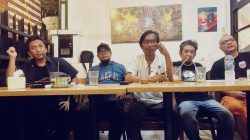

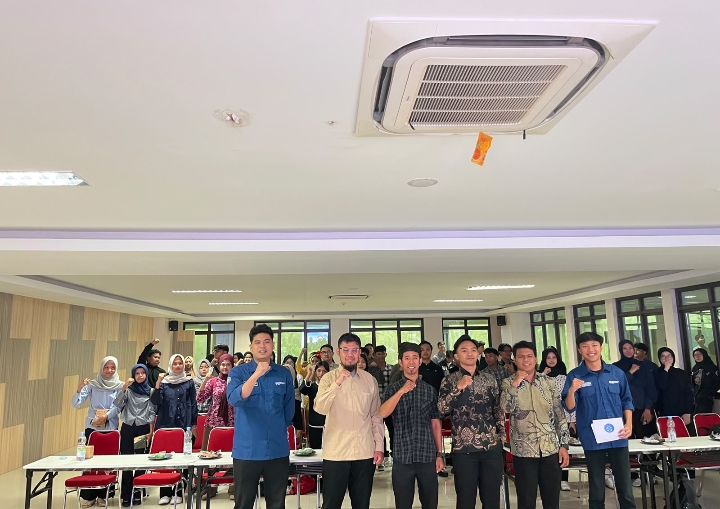
SERANG, October 28, 2026 – The Student Executive Board (BEM) of Sultan Ageng Tirtayasa University (Untirta) held a Food Security Seminar themed “Achieving Food Sovereignty: The Youth’s Contribution to Food Security” at Student Centre Room 03, on the Sindangsari Main Campus. The seminar brought together academics, local business owners, and students to discuss national food challenges and opportunities within the Banten region—covering topics such as agribusiness, the regeneration of the farming workforce, and the oversight of fertilizer subsidies.
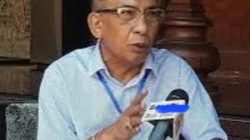
Rifqi Ahmad Riyanto, S.Si., M.Sc., a lecturer in Food Technology at Untirta, opened the seminar by presenting data from the 2022 Global Food Security Index (GFSI). Indonesia ranked 63rd out of 113 countries with a score of 60.2. While food affordability was rated as strong (ranking 44th), sustainability and adaptation remained weak (ranking 83rd). He explained that food security relies on four dimensions that must coexist: availability, access, utilization, and stability. Furthermore, the 2026 National Food Security and Vulnerability Map, issued by the National Food Agency, indicates that several areas in Banten still face food vulnerability.
According to data from the Central Statistics Agency (BPS), national rice production in 2025 increased by 13.29 percent, reaching 34.69 million tons. “This rise in rice production must be accompanied by equitable distribution so that the benefits can be felt by all segments of society,” said Rifqi.
He also highlighted climate-related risks. The Meteorology, Climatology, and Geophysics Agency (BMKG) has projected that the onset of the 2026/2027 rainy season will be delayed across 529 seasonal zones—covering 61.08 percent of Indonesia’s land area—amidst a very strong El Niño event. Regarding consumption, Rifqi urged participants to reduce food waste, which is estimated to reach 23–48 million tons annually. “Every individual has a role and responsibility in maintaining local food security,” he stated.
Read Also: Learn more about the case where a suspect status remained unresolved since 2018; Suhari wins a pretrial lawsuit against the Jakarta Metro Police.
Sarnata, S.P., Chairman of the Anugerah Aren Banten Nusantara (ARENTA) cooperative, serves as an inspiration for young people to contribute to food security through agribusiness. He highlighted that local food products from Lebak, Serang, and Pandeglang face challenges due to long-distance distribution. Palm sugar, for instance, is prone to damage, breakage, or melting, and its marketing remains heavily reliant on traditional markets.
The solution, according to Sarnata, is product diversification. “Palm sugar, which might initially be valued at IDR 20,000, can be developed into processed products with a selling price of up to IDR 80,000,” he explained.
For young people looking to start a similar venture, he emphasized the importance of obtaining official permits—such as those from the BPOM (Indonesian Food and Drug Authority)—and adopting a B2B (business-to-business) model to reach markets beyond Banten. “Building a business requires clear planning and structure from the very beginning,” he said. He noted that the first two years serve as an evaluation period to determine whether the business is worth continuing or if the strategy needs to be adjusted. His own venture currently supports 175 palm sugar farmers who supply the raw materials.
While agribusiness offers opportunities downstream, a major challenge upstream is the need for a new generation of farmers. Rafii Rizqi Ramadhan, Chairman of the Student Executive Board (BEM) of the Faculty of Agriculture at Untirta (2026), outlined three pillars of food security: physical availability, economic accessibility, and food utilization.
According to Rafii, many farmers have only an elementary school education and an average age of around 40. Meanwhile, according to the 2023 Census of Agriculture, there are 6.18 million millennial farmers—aged 19–39—accounting for 21.93 percent of all farmers in Indonesia.
Rafii highlighted the role of the “Merah Putih” Village Cooperative (Kopdes), which is now emerging as a designated point for the redemption of subsidized fertilizers. In accordance with Presidential Regulation Number 82 of 2026, subsidized fertilizers will henceforth be distributed through these village cooperatives. Consequently, university students should provide support and oversight to ensure that these cooperatives are effectively utilized by the farmers who are rightfully entitled to the subsidies. The requirements for redeeming subsidized fertilizer remain the presentation of an ID card (KTP) and registration in the Definitive Group Needs Plan (RDKK).
In Banten, out of a 2026 subsidized fertilizer allocation of 135,377 tons, Pupuk Indonesia had distributed 71,472 tons—or 53 percent—as of October 26, 2026. This consisted of 35,193 tons of urea and 35,765 tons of NPK. The current stock of subsidized fertilizer in Banten stands at 15,786 tons, and the remaining allocation is still available for farmers to redeem. According to Rafii, this indicates that other factors must be taken into account—such as weather conditions and the registration of farmers in the *e-RDKK* (electronic Definitive Group Needs Plan) system—meaning that the availability of fertilizer requires broad-based support to ensure it is utilized optimally.
Nationally, as of October 27, 2026, Pupuk Indonesia had distributed 7.41 million tons, representing 75 percent of the 9.8 million-ton allocation. This distribution is supported by an annual production capacity of 14.8 million tons and a current stock of 1.33 million tons of subsidized fertilizer.”Farmers in Banten still require subsidized fertilizer to support their agricultural activities,” said Rafii. However, “crop failure is not solely caused by issues regarding subsidized fertilizers; it can also be influenced by various other factors,” such as weather and land quality, which necessitates an approach that comprehensive.
Amid the threat of a prolonged drought, the government is preparing measures to safeguard water supplies, including weather modification operations. Additionally, the Indonesian National Armed Forces (TNI) have a “Manunggal Air” (Water Unity) program that farmers—including those in Banten—could potentially utilize, particularly for land that has historically relied solely on rainfall. This opportunity could be explored in coordination with farmer groups and local governments.
Rafii encourages students to take on a tangible role: from helping farmers understand the RDKK (Definitive Plan for Group Needs) registration process and urging them to join a *Gapoktan* (Association of Farmer Groups), to supporting and monitoring the implementation of *Kopdes* (Village Cooperatives) to ensure the initiatives reach their intended targets.
Read Also: Learn more about the case where Ade Batubara urges the North Sumatra Police Chief to investigate the former head of the Mandailing Natal (Madina) Health Office regarding alleged deductions of IDR 20–30 million from 2025 BOK (Operational Assistance Fund) allocations.
This seminar underscores that food security cannot be achieved by a single party alone. Through this initiative, it is hoped that concrete follow-up actions and sustained collaboration will emerge among the government, state-owned enterprises (BUMN), academics, students, farmers, youth, business operators, and all other relevant stakeholders. Whether through agribusiness, innovations in local food, or support for government programs, such collaboration is essential to realizing food sovereignty—from upstream to downstream—in Banten. (Ed.)