
PRIME NEWS POST
THE INDONESIAN– The Indonesian Customary Council (Majelis Adat Indonesia / MAI) is calling on the Provincial Government of West Sumatra, together with the regional legislature and all district and municipal administrations across the province, to immediately enact the Regional Regulation (Perda) on Adat Basandi Syarak, Syarak Basandi Kitabullah (ABS‑SBK) — a framework intended to strengthen customary law and give tangible effect to the state’s recognition of living law, or legal traditions practiced within communities.
Dato’ M. Rafik Datuk Rajo Kuaso, Secretary‑General of MAI, emphasised that the enactment of the new National Criminal Code — which formally recognises customary criminal provisions — marks a critical opportunity to reinforce the standing of customary law through local regulations.
“The Criminal Code now acknowledges customary offences, but implementation requires supporting regional rules. Therefore, we urge all local governments in West Sumatra to promptly finalise the ABS‑SBK Bylaw. Adat Basandi Syarak, Syarak Basandi Kitabullah must not remain merely a slogan or empty rhetoric. It is time to turn this principle into concrete policy,” he stated.
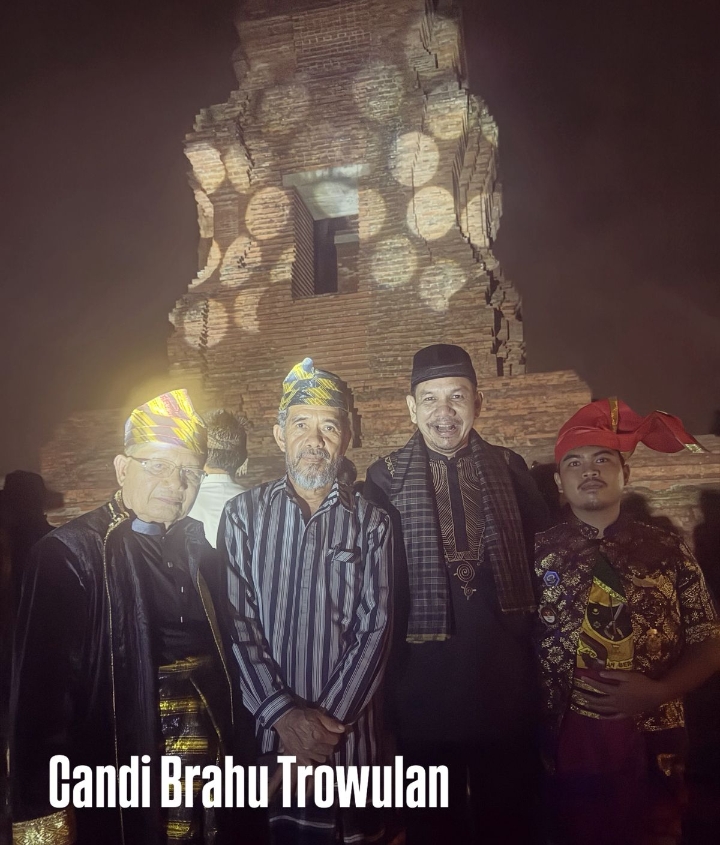
The remarks were delivered while M. Rafik attended as an honoured guest at the “Balaputra Nusantara Wilwatikta – Surya Mojopahit” gathering, held to welcome the Suro Month at Brahu Temple, Trowulan, Mojokerto, East Java. His presence represented part of MAI’s efforts to strengthen ties and cooperation among customary leaders across the archipelago in preserving cultural values and customary legal systems.
According to M. Rafik, the push for this regulation aligns with MAI’s broader commitment to initiate frameworks for living law in various regions — a follow‑up to Government Regulation No. 55 of 2025 on the procedures and criteria for recognising legal traditions practiced in society. MAI also encourages the preparation of academic papers to serve as a solid legal foundation for any bylaw governing customary law.
He noted that West Sumatra holds a strategic position, as the ABS‑SBK philosophy is not only a cultural heritage but also a core identity of the Minangkabau people, already recognised under national legislation. A formal bylaw is therefore needed to provide operational guidelines, ensuring the principle moves beyond abstract concepts into real application.
M. Rafik added that the views of West Sumatra’s leaders regarding the importance of the ABS‑SBK framework deserve serious attention from local authorities. The regulation, he said, would serve as a basis for guiding religious life, education, social affairs, culture, governance, and law enforcement — all rooted in shared customary and religious values.
He further highlighted growing social concerns, including drug abuse, gambling, corruption, illegal mining, the seizure of customary communal lands, and other forms of social deviance. Strengthening customary law through regional rules, he explained, is not intended to replace national law, but to complement it — reinforcing moral standards, protecting the rights of indigenous communities, and offering solutions to social issues based on values already accepted by the people.
“Rising social challenges require more than reliance on statutory law alone. Customary law must be strengthened as a moral anchor for society. Giving it legal certainty through a formal bylaw offers one strategic way forward,” he said.
In closing, M. Rafik called on the West Sumatra Provincial Government, the regional legislature, district and municipal administrations, customary institutions, religious scholars, community elders, traditional leaders, academics, and all segments of society to work together to accelerate the enactment of the ABS‑SBK Bylaw as a practical expression of Minangkabau philosophy.
“The time has come to embed Adat Basandi Syarak, Syarak Basandi Kitabullah in binding regulations that deliver legal certainty, strengthen the character of the nation’s youth, protect customary rights, and form the foundation for West Sumatra’s development — rooted in tradition, faith, and the Constitution of the Unitary State of the Republic of Indonesia,” Dato’ M. Rafik Datuk Rajo Kuaso concluded.
Reported from various media sources //photo from Google documents // contribution by Prime News Post international online media // news.paper
Related News