
PRIME NEWS POST
MADURA – The series of traditional and spiritual activities of the Parupuh Palace Aryo Menak Senoyo Madura continues with solemnity and profound meaning. Following the previous stages – the Sacred Nyello’ Aing Ritual at the Palace’s 7 Wells, followed by 40 nights of Quranic recitation (Tadarus Al-Qur’an) – the procession now enters its next important phase: the Dhudhus Traditional Ceremony, a purification ritual for prospective traditional leaders.
The Dhudhus Ceremony is a sacred procession involving a holy bath for the prospective King of Parupuh Palace. The ritual uses water from the palace’s seven wells, combined with water from a source in Jolotundo, on the slopes of Mount Penanggungan in Mojokerto, as well as seven types of flowers from seven gardens. It symbolizes physical and spiritual purification, covering the spiritual dimension known as the perfection of “Taretan Kaempa’ (Sedulur Papat)” – the body, soul, life force, knowledge – culminating in perfection through the monotheistic prayer Lailahaillallah Muhammadur Rasulullah (There is no god but Allah, and Muhammad is His messenger).
The prospective king is bathed by seven male relatives and seven female relatives, symbolizing balance and perfection. The procession also represents readiness to ascend the “seven steps of the celestial realm of the universe,” interpreted as leadership responsibilities across seven dimensions: religious leader, traditional community leader, palace leader, family leader, leader of relatives and warriors, leader of living beings, and leader of students and the younger generation.
The event is organized by the Traditional Custodian Institution of the Bujuk Gayam Foundation “Aryo Menak Senoyo,” which has legal standing under No. AHU-0006644.AH.01.12 Year 2018, and is based at Parupuh Palace, Jamburingin, Proppo Village, Proppo District, Pamekasan Regency, Madura.

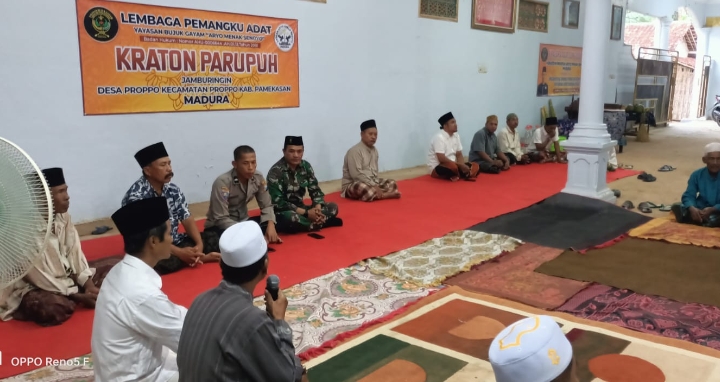
As part of the same series, several regional traditional leaders were officially inaugurated by senior traditional custodians. The inauguration symbolizes the strengthening of traditional institutional structures and the legitimization of leadership rooted in local wisdom.
The event was attended by government officials and authorities, including the Proppo District Police Chief, Proppo District Military Commander, Proppo Subdistrict Head, Proppo Village Head, as well as local traditional figures and regional traditional leaders.
The heir to Parupuh Palace, Kyai Raden Miftahussurur Fatah, S.E., emphasized that the entire series is a cohesive spiritual process designed to be continuous.
“After the Sacred Nyello’ Aing Ritual at the Palace’s 7 Wells was completed, activities continued with 40 days of Quranic recitation, which then extended into the holy month of Ramadan,” he stated.
He explained that the recitation of the Noble Quran ran from January 20, 2026, to February 28, 2026, and continued throughout Ramadan until its peak on the 28th day of Ramadan with a full-day Quranic completion ceremony (Khatmil Qur’an). This spiritual series concludes with the Dhudhus procession as a form of self-purification before entering the coronation phase.
The activity also forms part of the outreach and celebration of Eid al-Fitr 1447 H, while strengthening Islamic values integrated into traditional customs.
Previously, the commitment to this series of activities was presented at the Communication Forum of the Indonesian Traditional Council (Majelis Adat Indonesia/MAI) on January 22, 2026, which was attended by kings, sultans, datuks, queens, and traditional figures from across the Indonesian archipelago.
Next, the series of the Parupuh Palace Aryo Menak Senoyo Madura Song-Osong Traditional Ceremony will continue with key events:
• Traditional Assembly of the Parupuh Palace Traditional Consultative Body
• Traditional Assembly of the Indonesian Traditional Council (MAI)
• Sacred Coronation Ritual of the King of Parupuh Palace Aryo Menak Senoyo Madura
The entire series reaffirms the existence of Parupuh Palace as a traditional entity that maintains harmony between ancestral heritage, Islamic spiritual values, and archipelagic traditional order.
More than just a ceremony, this activity symbolizes the continuity of culture, spirituality, and dignified traditional leadership amid the dynamics of the times.
“Wassalamu’alaikum warahmatullahi wabarakatuh,” (Peace be upon you, and the mercy and blessings of Allah) concluded Kyai Raden Miftahussurur Fatah, S.E.