
PRIME NEWS POST
The INDONESIAN , (Jakarta) – There are phrases far older than the Republic of Indonesia, yet their meaning never fades: “Jalesveva Jayamahe” proclaims glory at sea, “Kartika Eka Paksi” affirms strength on land, and “Swa Bhuwana Paksa” guards the skies.
Yet between these three lies one realm of service bound by no land border, no coastline, no altitude. It is found in the daily lives of the people: on highways, in markets, villages, cities, houses of worship, digital spaces, disaster zones, conflict grounds, and the darkest alleys where crime hides.
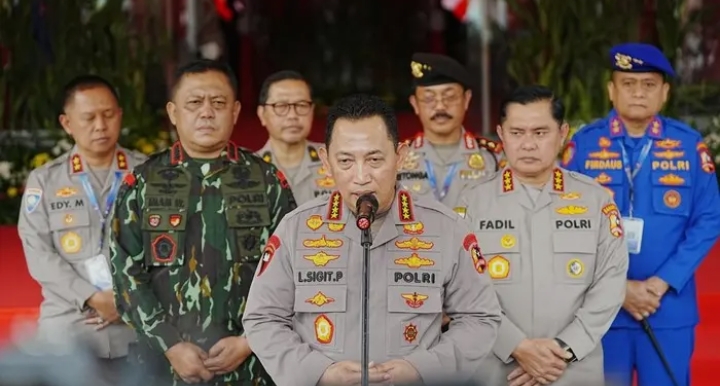
This is where the Indonesian National Police (Polri) serves. This is where Police General Listyo Sigit Prabowo carries his mandate.
While defense commanders guard the nation against threats from abroad, the Kapolri faces a task often far more complex: protecting the republic from fracture within itself.
These threats do not always take the form of armed forces. They may appear as terrorism, corruption, narcotics, cybercrime, social conflict, unequal law enforcement, street violence, information manipulation, or abuse of authority by the very officers sworn to serve.
The enemy often wears no uniform, flies no flag. At times, it grows within the institution itself.
That is why the Kapolri’s leadership cannot be measured solely by operations launched, arrests made, or cases closed. It is measured by the courage to wield state authority to uphold the law—even when that law must be applied to the powerful, high officials, capital owners, members of other institutions, or Polri personnel themselves.
It is by this standard that General Listyo Sigit’s tenure gains its historical weight.
Born in Ambon on 5 May 1969, Listyo Sigit graduated from the Police Academy in 1991. His career was not built on sudden leaps, but on steady progression through territorial posts: Commander of Pati Resort Police, Deputy Chief of Semarang Metropolitan Police, Chief of Surakarta Resort Police, assignments in criminal investigation, aide to the President, Chief of Banten Regional Police, Head of the Professionalism and Security Division, Head of the Criminal Investigation Agency, before being sworn in as Kapolri on 27 January 2021.
This sequence of postings exposed him to every facet of policing: public service, regional security, criminal investigation, internal oversight, relations with the head of state, and national organizational management.
He assumed office with a vision of transforming Polri toward “Presisi”—Predictive, Responsible, Transparent, and Fair. This is no mere slogan. It embodies a shift in policing philosophy: from reacting to disturbances to anticipating risks; from relying on formal power to embracing accountability; from closed procedures to publicly verifiable processes.
This vision positions the police not only as holders of coercive authority, but as an institution that must explain every use of that authority.
Yet history judges leaders not by the mottos they craft, but by the crises they never asked for.
Under Listyo Sigit’s command, Polri faced one of its gravest internal shocks: the murder of Brigadier Nofriansyah Yosua Hutabarat, which implicated then-Professionalism and Security Division Chief Inspector General Ferdy Sambo—the very body tasked with safeguarding discipline and integrity across the force.
This was no ordinary crime. It exposed how rank, command networks, information manipulation, and institutional mechanisms could allegedly be used to cover up killing.
Listyo Sigit faced two choices: preserve the institution’s image by limiting the case to its outer layers, or lay bare the fabrication—even if it meant exposing Polri’s internal wounds to the entire nation.
He chose the second path. Dozens of personnel were questioned, officers faced ethical and criminal proceedings, the initial cover-up was dismantled, and a two-star general stood trial as a defendant.
This decision did not erase all flaws in the initial handling. That is precisely its value. Leadership rarely operates in perfect conditions. Sometimes a leader must sever networks grown at the very heart of his organization, while bearing public anger over inherited systemic failures. Uncovering internal wrongdoing may tarnish reputation temporarily; concealing it destroys institutional legitimacy forever.
Polri was later tested by the Kanjuruhan tragedy, narcotics cases involving officers, controversies over law enforcement, and waves of alternating criticism. None of this can be glossed over with praise.
Worthy leadership is not that which appears faultless, but that which turns failure into institutional correction. A Kapolri does not become great because his institution is never wounded. He is measured by the courage to expose that wound, clean it, hold those responsible to account, and fix the system so the same injury never recurs.
In the years that followed, Listyo Sigit strengthened anti-corruption institutions by establishing the Polri Corruption Eradication Task Force (Kortastipidkor). Elevating this function from a directorate to a corps carries strategic meaning: anti-corruption is no longer a subset of economic crime investigation, but now commands its own structure, chain of authority, and enhanced organizational capacity.
In 2026, Kortastipidkor’s technical forums were further directed to strengthen investigators’ readiness for the new Criminal Code and Criminal Procedure Code.
The true weight of this reform became visible when Polri investigators dared to enter long-sensitive, off-limits territory—cases too close to power, too high-profile, too “untouchable.”
Corruption operations targeting vast networks, illicit fund flows, high-value assets, and alleged cross-institutional official involvement signal a critical shift: Polri can no longer merely maintain order among the public, while crimes backed by capital and rank enjoy immunity.
This courage is not hostility toward other institutions. A state governed by law knows no institutional solidarity that overrides investigative duty. Good inter-agency relations remain vital—but harmony must never become a silent pact to avoid scrutiny.
Healthy cohesion is built on respect for jurisdiction and willingness to hand anyone over to due process. Institutions are saved when individuals accused of abusing power are separated from the honor of their corps.
This is the distinction between loyalty to people and loyalty to the nation. Loyalty to individuals falters when they fall. Loyalty to institutions can devolve into corps protectionism. Loyalty to the nation demands a harder, quieter choice: uphold the law, even when the accused hold rank, connections, political influence, or the ability to strike back.
Listyo Sigit has also led Polri through two administrations. Appointed by President Joko Widodo in January 2021, he retained the trust of President Prabowo Subianto. This continuity is more than a long tenure. In a period of political transition, it signals that national security stability, legal continuity, and nationwide organizational stewardship require experience that cannot be built overnight.
Yet a longer tenure brings greater accountability. The longer one leads, the less room remains to blame predecessors. Every achievement becomes part of his record; every omission will also be attributed to him. The trust of two governments is no crown to wear—it is a growing debt of accountability.
Under his leadership, Polri’s scope has expanded beyond security and law enforcement to support food security, nutrition programs, national agenda protection, disaster response, and socioeconomic stability. In 2025, Polri reported maize cultivation across 661,112 hectares yielding 3.9 million tons, with further expansion planned for 2026.
This involvement must never blur core policing functions, yet it reflects modern security realities: food shortages spark unrest; unemployment fuels vulnerability; disinformation turns anxiety into conflict; disasters create disorder. In an interconnected world, security does not begin when crime occurs—it is built by identifying and preventing the factors that breed instability. This is where the “predictive” pillar of Presisi finds practical purpose.
Ultimately, however, Listyo Sigit’s legacy will not be defined by additional programs, buildings, apps, awards, or enforcement statistics. It will be measured by one far harder metric: do ordinary people feel the law exists for them, without money, status, or political connections?
Patrol cars, forensics labs, digital systems, Brimob, Densus 88, Bareskrim, Kortastipidkor, and hundreds of thousands of officers lose all meaning if citizens still fear reporting crimes because they believe no one will listen.
That is why his push to ensure the 110 emergency line responds quickly to public complaints is vital to reshaping the relationship between state and people. Police presence is not measured by sirens sounding after harm is done, but by the certainty that one call will bring help.
Gajah Mada once led the Bhayangkara to guard the king and protect the seat of power. Seven centuries later, the name Bhayangkara lives on in an institution with a far broader mandate: not guarding one ruler, but protecting all the people; not defending a throne, but upholding the constitution; not conquering territory, but ensuring no land is ruled by crime.
Listyo Sigit need not be cast as a new Gajah Mada—such comparisons diminish the complexity of his task. Gajah Mada served a royal order where the ruler’s will stood at the nation’s center. Listyo Sigit leads in a democratic republic, bound by the constitution, public oversight, due process, a free press, parliament, courts, and millions of citizens who test every action in seconds. Gajah Mada united lands through military power. The Kapolri must unite the nation through justice.
This work is quieter than war, yet its failure carries equal cost. Nations do not always fall to foreign invasion. They weaken when citizens lose faith that the law can still distinguish right from might. When that trust collapses, uniform authority remains—but without legitimacy.
Listyo Sigit’s journey is not yet complete. History’s verdict is not final, nor should it be rushed. He leads a vast institution marked by achievements, past burdens, structural gaps, and rising public expectations.
Yet one legacy is already clear: he ordered the law to turn inward upon Polri itself, strengthened anti-corruption machinery, weathered crises without abandoning command, and kept the institution standing when public trust was shaken by high-ranking misconduct.
A Kapolri’s oath is no Palapa Oath. He does not promise to conquer the archipelago or build an empire. His vow is closer, more concrete, tested daily: loyalty to the Unitary State of the Republic of Indonesia, obedience to the law, protection of the people, and defense of institutional honor.
The Palapa Oath spoke of territorial unity. Presisi must speak of unified law and justice—so that the rules that apply in narrow alleys also apply in official chambers; so that handcuffs that reach the common citizen do not lose their grip when facing generals, prosecutors, ministers, tycoons, or the powerful.
This is the mandate resting on Police General Listyo Sigit Prabowo. Not to be remembered as a man without fault, but to prove that in this republic, leaders still exist who dare to clean their own house, cross once-inviolable lines, and place the law above rank and friendship.
For in the end, a general is not measured by how many troops salute him. He is measured by whether the power entrusted to him ensures ordinary people no longer bow before injustice.
Reported from various media sources //photo from Google documents // contribution by Prime News Post international online media // news.paper
Related News