
PRIME NEWS POST
The INDONESIAN – Y.M. Iftiqar S.A. Ponto, Senior Prince of Bolangitang and North Sulawesi historian, presented the significance of two historical documents that stand as authentic testimony to the late S.A.S. Ponto’s lifelong service, during a communication forum of the Majelis Adat Indonesia (MAI) attended by kings, sultans, datuks, queens, and customary leaders from across the archipelago.
In his address, Iftiqar S.A. Ponto explained that the documents are far more than administrative records; they trace how a son of Bolangitang, North Sulawesi, earned recognition for his expertise and dedication both under the Dutch Kingdom and after Indonesia’s independence.
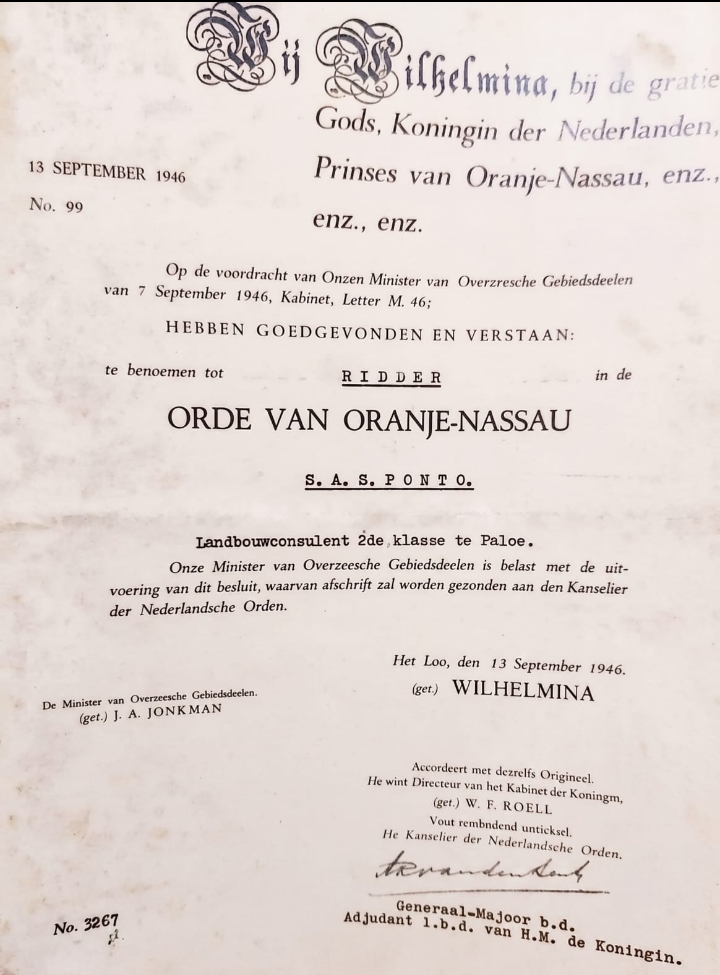
The first document is a Decree of the Dutch Kingdom signed by Queen Wilhelmina on 13 September 1946. By this instrument, S.A.S. Ponto was formally conferred the title of Ridder (Knight) in the Order of Orange-Nassau, one of the Netherlands’ highest civilian honours.
The award was granted in recognition of his contributions to agriculture while serving as Landbouwconsulent Tweede Klasse (Second Class Agricultural Consultant) in Paloe (Palu), Sulawesi. It reflected recognition of his professionalism, integrity, and impact on advancing the agricultural sector.

“This document means more than an award; it proves that dedication, knowledge, and service to the community transcend borders and eras. History must be read as a complete legacy that inspires future generations,” Iftiqar stated on 26 July 2026.
He went on to recount that after independence, S.A.S. Ponto’s competence and integrity once again earned the trust of the Government of the Republic of Indonesia.
This is confirmed by Presidential Decree No. 173 of 1951, which appointed S.A.S. Ponto as Head of the Indonesian Delegation to the International Meeting on Land Utilisation in Tropical Regions, convened by the Food and Agriculture Organization (FAO) in Nuwara Eliya, Ceylon (now Sri Lanka), from 17 to 29 September 1951.
At the time serving as Senior Officer at the Land Planning Centre in Bogor, S.A.S. Ponto was entrusted to lead the delegation alongside A.H.J. Kroon, representing the nation at the global forum addressing land use for agricultural development and food security across tropical zones.
According to Iftiqar, these historical facts demonstrate the continuity of S.A.S. Ponto’s service.
“He was honoured for his achievements in agriculture, and after independence was again entrusted by the nation to carry Indonesia’s name abroad. This shows that competence, dedication, and devotion to science are values recognised across successive governments,” he said.
Iftiqar also recalled that S.A.S. Ponto’s impact extended beyond agriculture. As a scientist, he co‑authored the landmark 1932 publication “De Teken van den Oost-Indischen Archipel” with B.J. Krijgsman, a key reference in zoology and biology, particularly research on ticks in the Dutch East Indies.
As S.A.S. Ponto’s grandson, Iftiqar expressed hope that his grandfather’s life journey would inspire Indonesia’s youth.
“A great nation is one that honours the contributions of its predecessors. S.A.S. Ponto’s legacy teaches us that knowledge, service, integrity, and hard work are the foundations of nation‑building. These are the values that must be passed on to Indonesia’s younger generation,” he emphasised.
Before the assembly of customary leaders, Iftiqar also affirmed that the Majelis Adat Indonesia holds a strategic role in safeguarding national historical memory, including raising awareness of regional figures who advanced Indonesia at home and on the global stage.
Remembering leaders such as S.A.S. Ponto is not merely about honouring the past; it is about nurturing a national character that values knowledge, service to the state, and commitment to progress—especially in strengthening agriculture, food security, and human resource development.
Reported from various media sources //photo from Google documents // contribution by Prime News Post international online media // news.paper
Related News