
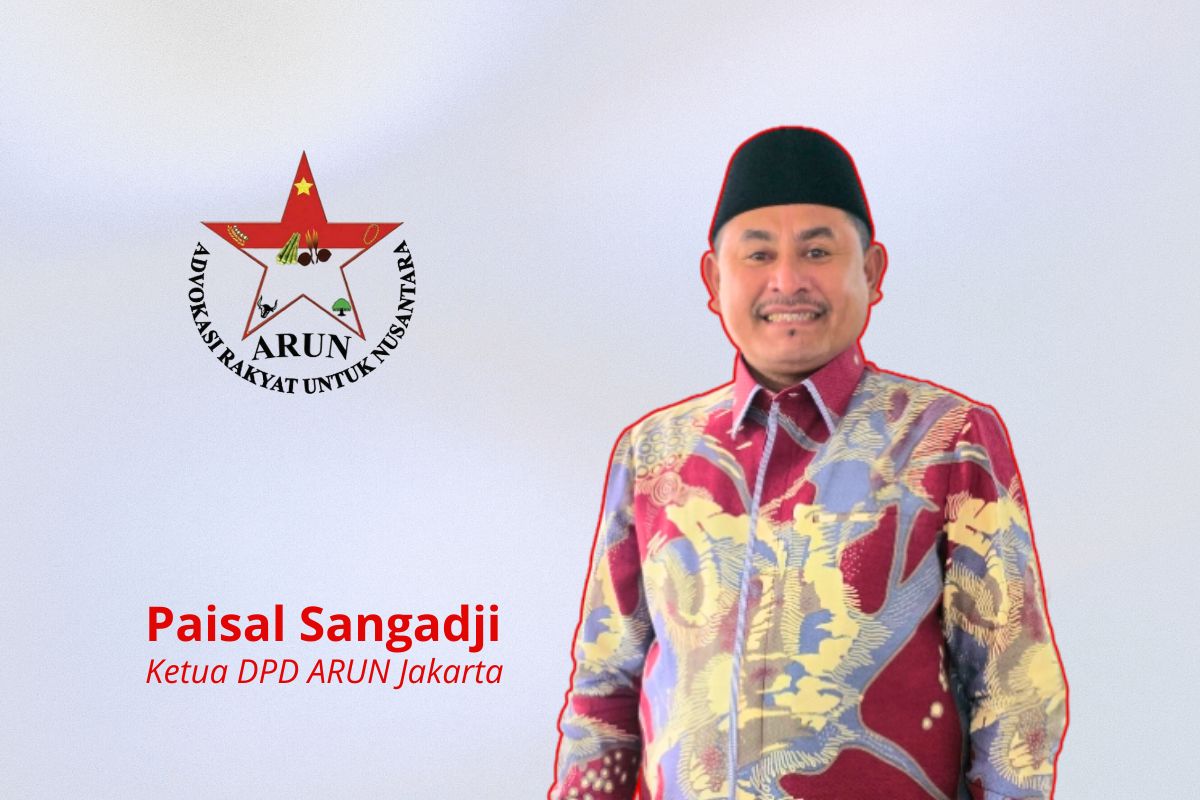
Jakarta – The deadly collision between the Argo Bromo Anggrek long-distance train and the Commuter Line KRL at East Bekasi Station on Monday night, April 27, 2026, continues to draw sharp criticism. Not only the government and the DPR (People’s Representative Council), but civil society organizations have also begun to loudly demand a complete overhaul of Indonesia’s railway safety system. One of the most vocal voices comes from the Chairman of the Regional Leadership Council of the People’s Advocacy for the Archipelago (DPD ARUN) Jakarta, Paisal Sangadji.
This tragic incident, which claimed at least 15 lives and injured dozens more, can no longer be seen as an ordinary accident.
The chronology of the event began when a Green SM electric taxi was hit by a KRL at the JPL 85 level crossing, which then triggered a series of chain events. The KRL that stopped due to that incident was followed by another KRL train stopping at East Bekasi Station. At that moment, the Argo Bromo Anggrek train coming from behind failed to stop in time and eventually crashed into the rear of the stationary KRL.
The accident highlights various fundamental weaknesses in our public transportation system, ranging from weak signaling systems, the vulnerability of level crossings, to the lack of coordination between control units. The public fears that this is not the first incident and could lead to even greater tragedies if no total improvement is made.
For that reason, Paisal Sangadji urged the Government of the Republic of Indonesia, through the Ministry of Transportation and PT Kereta Api Indonesia (KAI), to immediately conduct a total evaluation and comprehensive audit of land transportation safety management.
“The incident at East Bekasi Station is a loud alarm that cannot be ignored. It is a real indication of a systemic failure that can no longer be tolerated,” Paisal Sangadji emphasized in a written statement to the media on Wednesday (April 29, 2026).
Paisal firmly demanded improvements to the signaling and control systems by ensuring that train protection technology such as “Automatic Train Protection” (ATP) is implemented evenly.
He also urged total handling of the approximately 1,800 dangerous level crossings in Indonesia, including closing them or building flyovers to separate the tracks.
Furthermore, he said an internal audit of KAI’s management must be carried out immediately to evaluate the standard operating procedures (SOPs) for train traffic management, especially on congested lines where commuter and long-distance trains mix.
Not to be overlooked, he also requested safety inspections of all public transportation fleets, especially electric taxis, to prevent similar incidents in the future.
“The safety of the people’s lives can no longer be compromised for the sake of cost or operational efficiency,” Paisal said firmly. “The government must dare to act decisively and quickly. If necessary, stop operations on dangerous tracks until all safety systems are guaranteed,” he added.
ARUN’s calls added to the long list of demands from various elements of society who want real action following this tragedy. Previously, Abdul Hadi, a member of the DPR’s Commission V, also urged a comprehensive evaluation, especially regarding signaling and crossing safety.
At the government level, President Prabowo Subianto has ordered KAI to conduct a thorough evaluation and prepare a budget of Rp 4 trillion to build flyovers at 1,800 dangerous level crossings.
In response to President Prabowo’s step, the Chairman of DPD ARUN Jakarta, Paisal Sangadji, expressed positive appreciation.
“We at ARUN Jakarta give the highest appreciation to President Prabowo Subianto for his commitment to building flyovers and guard posts at every railway crossing. This is a concrete step that has long been awaited,” said Paisal.
Not to be left out, a transportation expert from the Indonesian Transportation Society (MTI) assessed that the construction of a double-double track on the Bekasi-Cikarang line must be implemented immediately to separate KRL and intercity train tracks.
In the midst of deep sorrow, ARUN Jakarta, through its chairman Paisal Sangadji, invited all components of the nation to oversee the investigation process conducted by the KNKT (National Transportation Safety Committee).
According to Paisal, the results must become the foundation for concrete, measurable, and supervised policies. This momentum must become a turning point for the realization of truly safe, comfortable, and disciplined public transportation.