
PRIME NEWS POST
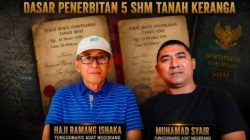
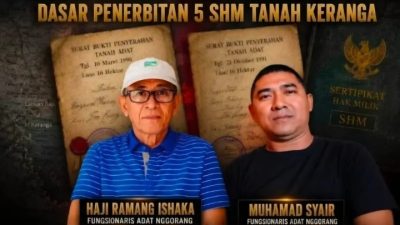
The INDONESIAN– The controversy surrounding the land dispute in Kerangan, Labuan Bajo Village, has heated up once again. Statements by Nggorang Customary Officials, Haji Ramang Ishaka and Muhamad Syair, claiming they were merely witnesses, have triggered a strong response from the heirs of the late Ibrahim Hanta.
Through their legal counsel, Irjen Pol (Ret.) Drs. I Wayan Sukawinaya, M.Si., the heirs emphasized that the root of the problem is not as simple as the claim of being “just witnesses.” He stated that the complex dispute originated from an alleged engineered land transaction covering 40 hectares, which is deemed inconsistent with the actual facts on the ground.
“If traced back, it all started with the Sale and Purchase Deed (PPJB) in 2014 between Nikolaus Naput and Santosa Kadiman. From there, strong indications of land mafia practices are evident,” stated Sukawinaya on Monday (05/04/2026).
40-Hectare Claim Questioned
According to Sukawinaya, the facts on the ground show significantly different figures.
Based on data presented during the trial at the Labuan Bajo District Court, the total verifiable land area is only approximately: 16 hectares (based on a document dated March 10, 1990) and 11 hectares (based on a claim from a document dated October 21, 1991, under the name Beatrix Seram Nggebu). The actual total is 27 hectares.
So where is the remaining 13 hectares from the claimed 40 hectares?
“If there is only 27 hectares, then where is the other 13 hectares? In the sea? Or did it become state land?” questioned the former high-ranking National Narcotics Agency (BNN) official sharply.
BPN Allegedly “Deceived” by Flawed Documents
In his latest statement, Sukawinaya also highlighted the role of the National Land Agency (BPN) of West Manggarai. He suspects that the issuance of the certificates, which serve as the basis for the current claim, involved serious negligence during the verification process.
According to him, BPN was allegedly “deceived” by documents submitted by Haji Ramang Ishaka and Muhamad Syair, who at the time represented themselves as officials of the Nggorang Customary Institution.
“Because they carried the title of customary officials, BPN seemingly trusted them immediately. The attached documents were accepted without thorough examination,” he asserted.
He added that BPN should not have stopped at administrative checks alone, but was obliged to verify the authenticity of the documents and match them with the physical location of the land.
“The question is, was the authenticity of the March 10, 1990 document ever seriously verified? Where are the land coordinates? Do they truly match the claims?” he asked.
Sukawinaya believes that weak verification opened the door for data manipulation, ultimately leading to the issuance of certificates based on unclear grounds.
“If the foundation is wrong from the start, then the legal product is also potentially flawed. This must be uncovered,” he said.
Role of Customary Officials in 2014 Under Scrutiny
Aside from the land area issue, Sukawinaya firmly pointed out the involvement of Haji Ramang Ishaka and Muhamad Syair during the measurement process in 2014.
He revealed three key facts: Both were present at the location during the measurement and participated in the process alongside BPN officers. They even signed the measurement documents as Customary Officials.
“Do not pretend now that you were just witnesses. In 2014, they participated in the measurement and signed the documents. That is an undeniable fact,” he stated.
Furthermore, Sukawinaya questioned the legal basis for the subsequent land documents issued, namely:
– 5 certificates issued in 2017 (total ±16 hectares)
– 4 Measurement Drawings (GU) totaling ±11 hectares
According to him, the entire process was based on two documents that are currently considered problematic. These include the customary land letter dated March 10, 1990 — alleged to have no original copy — and the letter dated October 21, 1991 — which lacks clarity regarding area and boundaries.
“These two documents became the foundation for the 40-hectare claim. Yet their validity is still questionable, and it is even said that the originals do not exist,” he revealed.
He considers this issue no longer a mere administrative error, but points toward alleged systematic practices involving multiple parties.
Names such as Santosa Kadiman, Haji Ramang Ishaka, Muhamad Syair, and the family of Nikolaus Naput are mentioned as being at the center of the conflict, which is now having a broad impact, including on the investment climate in Labuan Bajo.
“If the foundation is flawed, then everything built upon it is also flawed,” he said.
Key Unanswered Question
Amidst the ongoing controversy, Sukawinaya emphasized one fundamental question that remains unanswered:
“Where are the 13 claimed hectares located, if there is only 27 hectares on the ground?”
He challenged the involved parties to transparently disclose their involvement in the 2014 measurement process.
Strong Warning: Do Not Lie or Be Greedy
Concluding his statement, Sukawinaya delivered a stern warning with both moral and legal implications.
“Land is not merely an asset. It concerns the future of generations. Do not lie, do not be greedy. Everything has consequences—both under state law and moral law,” he emphasized.
Previously, Haji Ramang Ishaka and Muhamad Syair denied their involvement in the dispute. They asserted that their presence at the National Police Criminal Investigation Agency (Bareskrim) was solely to respond to an investigator’s summons as witnesses.
“We came only to provide clarification regarding the customary land handover letter dated March 10, 1990. We are not the disputing parties,” said Haji Ramang.
He explained that in their capacity as Nggorang Customary Officials, they only conveyed information based on available documents and knowledge, without being involved in the buying and selling transaction.
According to him, the process began with the handover of land to Nasar Bin Haji Supu, which was then transferred via sale to Nikolaus Naput around 1990.
“After that, the measurement, certification, and issuance processes were matters between the other parties. We had no intervention,” he stated.
Their legal representative, Gabriel Kou, S.H., emphasized that allegations of document forgery cannot be made lightly without valid legal proof.
“In criminal law, responsibility lies with the direct perpetrators. Accusations must be proven through forensic testing and compared against original documents,” he said.
He also reminded that editorial differences in customary documents do not automatically constitute forgery.
“Do not build public opinion without strong evidence,” he concluded.
Reported from various media sources //photo from Google documents // contribution by Prime News Post international online media // news.paper
Related News