
PRIME NEWS POST
The INDONESIAN, (Jakarta)— The volunteer group Prabowo Mania 08 has voiced its support for the political statement issued by the 98 Resolution Network during the commemoration of 28 years since Indonesia’s political reform movement. The event carried the theme “Towards the Transformation of Economic Democracy: From 28 Years of Freedom of Expression to Equitable Prosperity Under the Prabowo-Gibran Administration.”
This support was formally conveyed by the Secretary-General of Prabowo Mania 08, Agustin Lumban Gaol, through a media release in Jakarta on Sunday (24/5/2026).
Agustin explained that the stance taken by the 98 Resolution Network reinforces a shared commitment to monitor, oversee, and fully support President Prabowo Subianto and Vice President Gibran Rakabuming Raka in the administration of government.
“We endorse the statement delivered by Haris Rusli Moty, Coordinator of the 98 Resolution Network, in support of the government’s efforts to improve the welfare of the Indonesian people through the Asta Cita programs of the Prabowo-Gibran administration,” Agustin said.
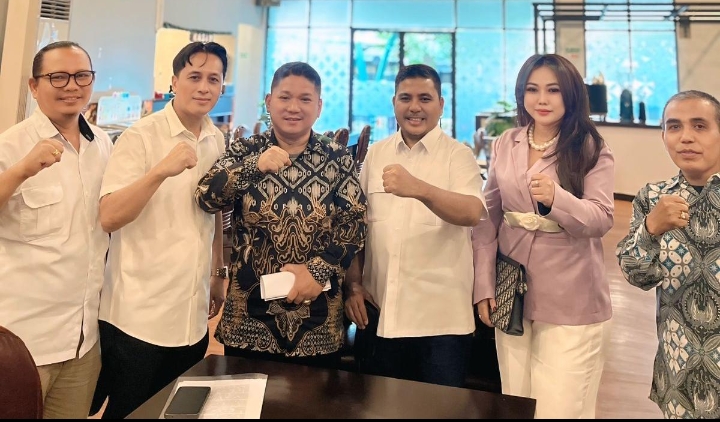
He noted that the move by the Coordinator and Founding Father of the 98 Resolution Network — accompanied by 51 activists from the class of 1998 — during the reading of the political statement at Batik Kuring, SCBD, South Jakarta, served as a reflection on the journey of the 1998 Reform movement.
“As figures from the reform movement, we call upon all stakeholders of the reform era to engage in introspection, especially now, decades after the movement succeeded in ending 32 years of New Order rule,” Agustin stated.
“This reflection is critical, because over these 28 years of reform, imbalances have emerged. In particular, achievements in political democratization have not been matched by progress in economic democratization or the equitable distribution of prosperity among the people,” he emphasized.
According to him, during the commemoration of the 27th anniversary of reform one year ago, the group reaffirmed its commitment to preserving the political democracy achieved during the reform era — particularly through the institutionalization of democratic bodies and civil society.
“These achievements include freedom of the press, freedom of expression, regular elections, and the right to organize and establish political parties — all guaranteed under the 1945 Constitution. However, in our view, if political democratization does not occur simultaneously with economic democratization, what we actually have is a pseudo-democracy — a democracy in name only,” Agustin explained.
This former 1998 activist added that the situation is further complicated when national wealth — including land, water, natural resources, and state assets — is controlled only by a small elite group, referred to as the “serakahnomic” class or predatory economic interests. In such cases, political democracy is effectively hijacked, along with the fundamental livelihood rights of the majority.
“On this 28th anniversary of Reform, we call for a return to the mandate of the nation’s founders. The Proclamation of Indonesian Independence on 17 August 1945 was intended to establish a state that protects all the people of Indonesia, liberates them from poverty and ignorance, and fulfills the mandate to alleviate suffering,” Agustin said.
Reform and the Fundamental Consensus of Democracy
Agustin further argued that the implementation of the reform mandate must be grounded in the fundamental consensus that led to Indonesia’s independence. In pursuing the vision of people’s welfare, he cited the view of Indonesia’s founding President Sukarno that the democratic system chosen by the nation is not Western-style liberal democracy, but rather Socio-Democracy.
“According to Bung Karno, Western-style liberal democracy guarantees people the right to speak freely and cast votes in elections. Yet, at the same time, it denies them easy access to manage the nation’s wealth — the very resources that could lift them out of poverty,” he noted.
Agustin also explained that under a liberal system, the voice of the people is often overpowered by the voice of capital. Public opinion, which shapes what is perceived as collective consciousness, is frequently controlled by owners of capital. Consequently, the aspirations of the majority are drowned out by the interests of the predatory economic elite.
“As figures of the reform movement who now support the Prabowo-Gibran administration, we wish to clarify — on this anniversary — that the vision and programs of the current government align with the mandate of the 1998 Reform and the principles of economic democratization enshrined in the 1945 Constitution, particularly Article 33,” he explained.
There are several key alignments highlighted:
First, the reform-era demand to “seize corrupt assets to subsidize the people” has been acted upon by President Prabowo. Activists will recall this slogan, which appeared on protest banners and echoed through speeches at demonstrations nationwide.
Examples of such actions include:
1. The seizure of IDR 13.25 trillion in funds linked to corruption in the crude palm oil (CPO) industry involving the Wilmar Group.
2. The recovery of IDR 11.42 trillion in administrative fines and assets related to violations of forestry and land regulations involving multiple corporations.
3. Confiscation of IDR 920 billion in cash and 51 kilograms of gold linked to case brokering practices within the Supreme Court, involving Zarof Ricar.
4. Intensified crackdowns on corruption within the oil and gas sector, targeting figures such as Riza Chalid — a major player long thought untouchable by the law. President Prabowo has affirmed that all assets seized from corruption will be used for public benefit, including the construction of schools, fishing villages, and public infrastructure.
Second, the anti-corruption approach has become more progressive, shifting focus toward offenses related to state revenue and resource management — in line with the reform mandate.
“Previously, anti-corruption efforts focused primarily on irregularities in state spending, whose value is far less than the losses incurred through corruption involving state revenues and resources,” Agustin noted.
He added that President Prabowo’s approach emphasizes addressing systemic inefficiency, preventing budget waste, and plugging leaks starting from the upstream management of national income and resources.
“This progressive anti-corruption strategy targets corruption in natural resource management and the misuse of concession permits,” he said.
Finally, Agustin urged the public to safeguard the political democracy that has been achieved, using it as a tool to accelerate the realization of economic democracy and equal prosperity.
“We will actively engage in dialogue with various community groups to explain the foundation and direction of President Prabowo’s strategic programs. At the same time, we remain committed to monitoring and ensuring the proper implementation of his vision,” Agustin concluded.
Reported from various media sources //photo from Google documents // contribution by Prime News Post international online media // news.paper
Related News