

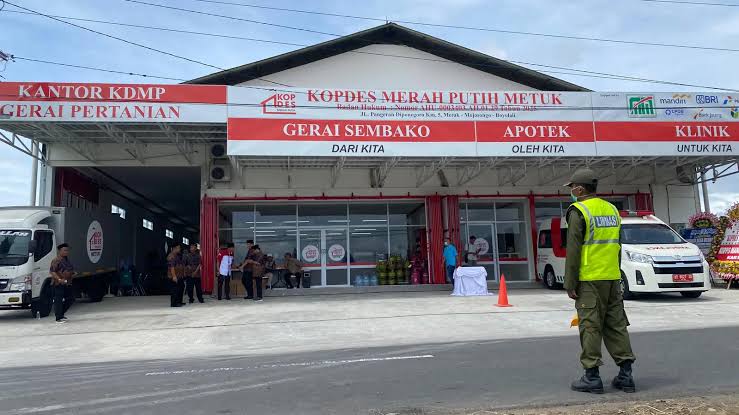
Jakarta – The Red and White Village/Subdistrict Cooperative (KDKMP) is a national priority program initiated by President Prabowo Subianto to strengthen village and subdistrict economies through 80,000 cooperatives based on mutual cooperation. The program focuses on food security, distribution of agricultural and fisheries products, provision of affordable basic necessities, savings and loans, as well as the digitalization of micro-enterprises to accelerate efficiency and local economic independence.
Recently, the government opened 30,000 positions for managerial roles within the KDKMP program. This initiative has drawn attention from economic observer Nailul Huda, who views the government’s move through the KDKMP program as an effort to realize local economic independence.
“I observe that President Prabowo shares a similar vision with Soemitro Djojohadikoesoemo, his father, namely channeling funds to the public through cooperatives based on local economic independence,” said economist Nailul Huda in Jakarta on Saturday (April 18).
Nailul Huda believes that the KDKMP program aims to bring communities closer to the market. However, he also notes that the Red and White Village Cooperative program tends to be overly top-down.
“The KDKMP program has good intentions. I see it as an effort to cut out middlemen and bring communities closer to the market. However, the policy appears too top-down, whereas cooperatives are fundamentally built among members themselves, not merely based on government program implementation,” he said.
Furthermore, Nailul Huda emphasized that KDKMP, particularly the Red and White Village Cooperative, should be aligned with Village-Owned Enterprises (BUMDes), which already exist in every village.
“KDKMP must be aligned or integrated with BUMDes, so that BUMDes products can be sold or marketed through this cooperative network. In addition, products from state-owned enterprises (BUMN) and local businesses can also be marketed through KDKMP, enabling people to purchase local products from both state-owned and private sectors,” he explained.
Nailul Huda also raised concerns regarding the implementation of the Red and White Village/Subdistrict Cooperative program, which is currently operated by PT Agrinas Pangan.
“The KDKMP program is currently being implemented through an inappropriate system, namely under PT Agrinas Pangan. If we refer to Mr. Soemitro’s ideals, it should be corrected by shifting the cooperative model back to a bottom-up system,” he asserted.
Moreover, the Director of CELIOS also commented on the growing digital economy climate in Indonesia.
“There is growth in our digital economy climate. This is evident from the declining number of ATMs and the increasing use of QRIS,” he said.
Regarding Indonesia’s digital economy, Nailul Huda stressed that it must first be built from its foundational aspects.
“When discussing the digital economy climate in Indonesia, we must start from the basics. While millions use QRIS, they are mostly consumers, not producers within the digital economy,” he added.
“This is unfortunate because our country is the world’s largest nickel producer, yet we have not been able to develop a semiconductor industry, which is the foundation of the digital economy,” he continued.
Finally, Nailul Huda emphasized that building a strong digital economy requires three key elements: competent human resources, advanced equipment, and fair regulations.
“These three elements must be implemented continuously to sustain and drive the growth of Indonesia’s digital economy,” concluded the CELIOS Director.