
PRIME NEWS POST
The INDONESIAN , (Jakarta)— Amid the towering skyscrapers lining the Sudirman to Thamrin corridors, an idea has taken root, drawn from the very roots of Betawi culture. This vision goes far beyond preserving traditions; it seeks to transform how indigenous communities view their economic future.
For David Darmawan, a prominent Betawi figure known for advocating community asset governance, sustainable development, and the adoption of financial technology, safeguarding one’s village means more than maintaining traditional homes or holding cultural festivals. To protect the village, he believes, is to ensure future generations hold firm economic ownership.
The principle he often shares is simple yet profound:
“Guard the village, uphold honor and conduct.”
This value, David says, is a legacy from Betawi ancestors, teaching that progress must never erase identity, and modernization must advance hand-in-hand with respect for cultural heritage.
From Betawi Villages to the Global Economy
Born and raised in Jakarta as a son of Betawi, David has witnessed the city’s transformation firsthand. He has watched areas once home to Betawi communities evolve into bustling business districts and modern residential zones.
For him, the greatest challenge lies not merely in physical changes to the city, but in ensuring local communities remain active participants in the economic growth taking place around them.
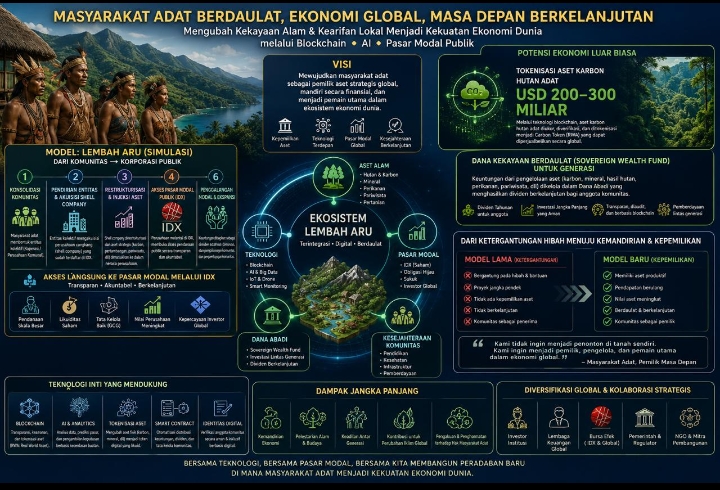
With this in mind, he has developed a framework that integrates blockchain technology, artificial intelligence (AI), capital markets, and green finance principles as tools to empower indigenous communities economically.
In his writings and public discourse, David argues that community assets—ranging from management rights and cultural heritage to sustainable economic potential—should not be viewed solely as historical legacies, but as development capital that can be managed professionally, transparently, and with a long-term outlook.
He believes digital technology can strengthen governance transparency, improve asset documentation, and unlock access to financing that was previously out of reach for local communities.
From Aid Recipients to Owners
David asserts that the prevailing development paradigm for indigenous communities must shift.
For decades, many empowerment programs have relied heavily on grants and short-term projects, even as economic challenges grow increasingly complex.
Communities, he argues, need instruments that allow them to build productive assets, strengthen economic institutions, and establish sustainable sources of income.
He envisions modern cooperatives, community-owned enterprises, and the strategic use of capital markets as alternative financing pathways—all grounded in sound governance and regulatory compliance.
“It is not enough simply to receive assistance; people must become co-owners and creators of economic value,” as he often states.
Green Finance as a New Pathway
Environmental stewardship lies at the heart of this vision.
David believes the future economy will be defined by sustainability, conservation, and responsible management of natural resources.
Accordingly, he focuses on instruments such as green financing, sustainable investment, carbon markets, and the digitalization of asset governance.
He notes that Indonesia possesses extraordinary natural and cultural wealth to become a key player in the global green economic transformation—provided these assets are managed with strong governance and supported by appropriate technology.
AI and Blockchain for Transparency
As artificial intelligence and blockchain technology advance rapidly, David sees new opportunities for local communities.
These tools, he explains, are far more than passing digital trends; they can enhance accountability, administrative efficiency, asset tracking, and the fair distribution of economic benefits.
At the same time, he emphasizes that technology must be applied within the framework of national law, community protection, and responsible oversight.
Preserving Identity in a Global City
David believes Jakarta’s status as a global city should never come at the cost of the Betawi community’s right to thrive.
On the contrary, cultural identity can serve as a foundation for building new economic competitiveness.
Culinary heritage, performing arts, crafts, village history, and the spirit of mutual cooperation all hold untapped potential—ready to be developed through creative economy approaches, digital innovation, and cross-sector collaboration.
His vision is not merely to preserve culture as a relic of the past, but to embed it in the economy of the future, delivering tangible benefits to communities.
Bridging Tradition and Innovation
Throughout his work, David holds fast to a belief passed down by Betawi elders:
That progress must never make one forget their roots.
That technology should strengthen human values.
That economic development must not only generate growth but also uphold the dignity of those who first built this city’s civilization.
Amid sweeping digital transformation and global economic shifts, his ideas offer an alternative path: modernization firmly rooted in culture.
Perhaps this is the true meaning of “guard the village, uphold honor and conduct”—a call to ensure economic progress moves in step with identity, sustainability, and responsibility to generations yet to come.
Editorial Note: For publication in outlets such as Kompas, this article would be strengthened by direct interviews with David Darmawan, insights from academic experts, and verified data from official sources including BPS, OJK, IDX, KLHK, and AMAN. Any investment projections or scenarios should be presented as conceptual ideas rather than established facts.
Reported from various media sources //photo from Google documents // contribution by Prime News Post international online media // news.paper
Related News